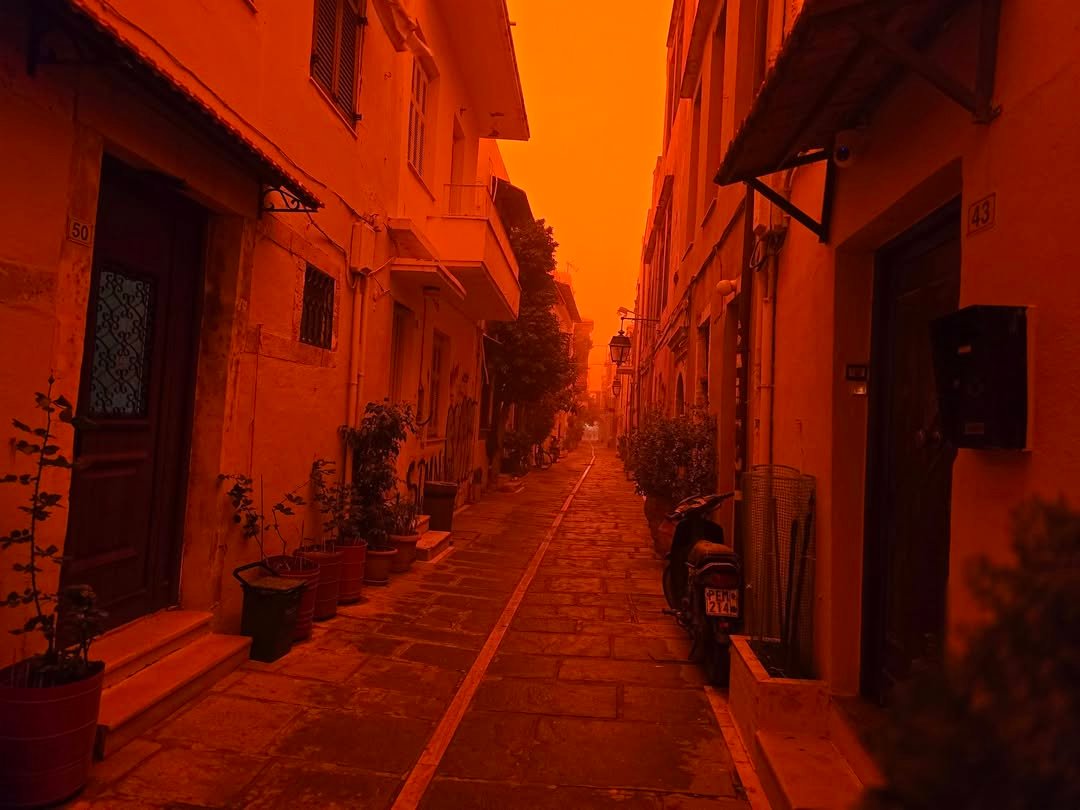
On Wednesday, April 1st 2026, Crete woke up to blue skies and ended the day on what looked like another planet. By midday, a massive plume of Saharan dust carried by Storm Erminio had swallowed the island whole.
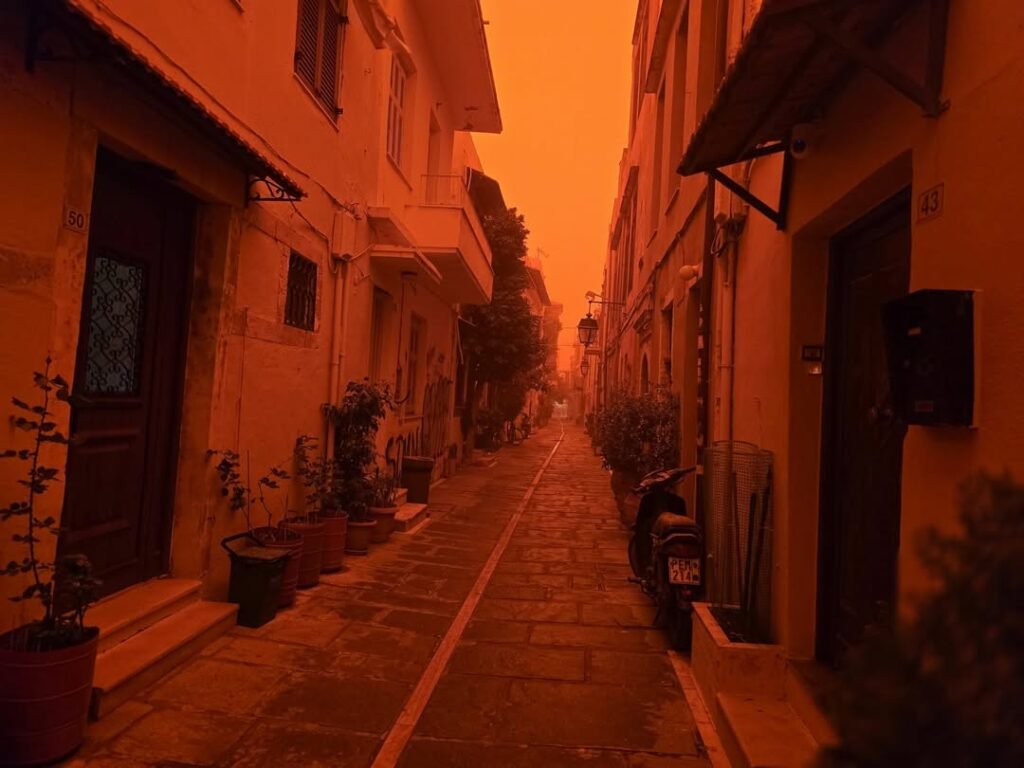
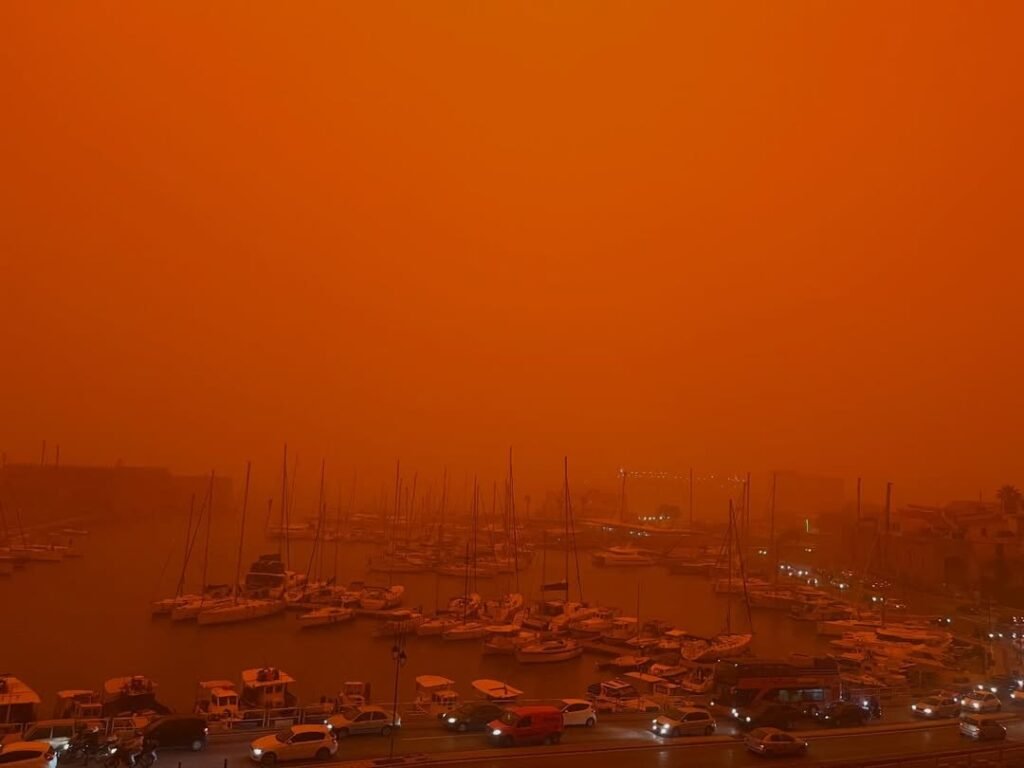
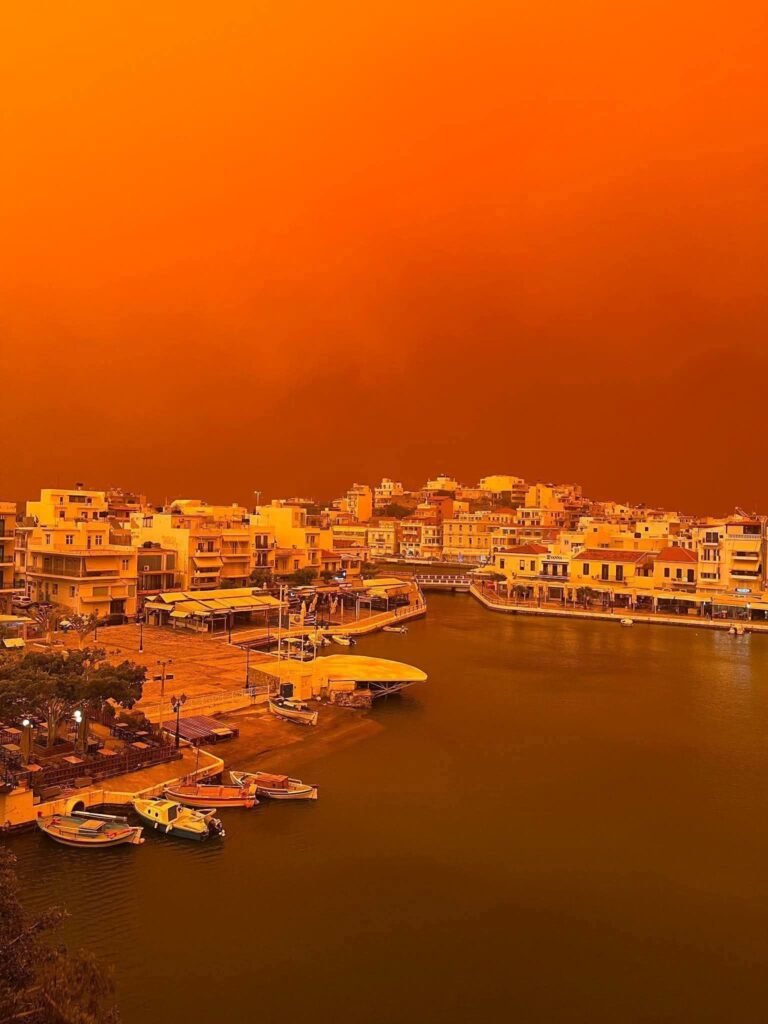
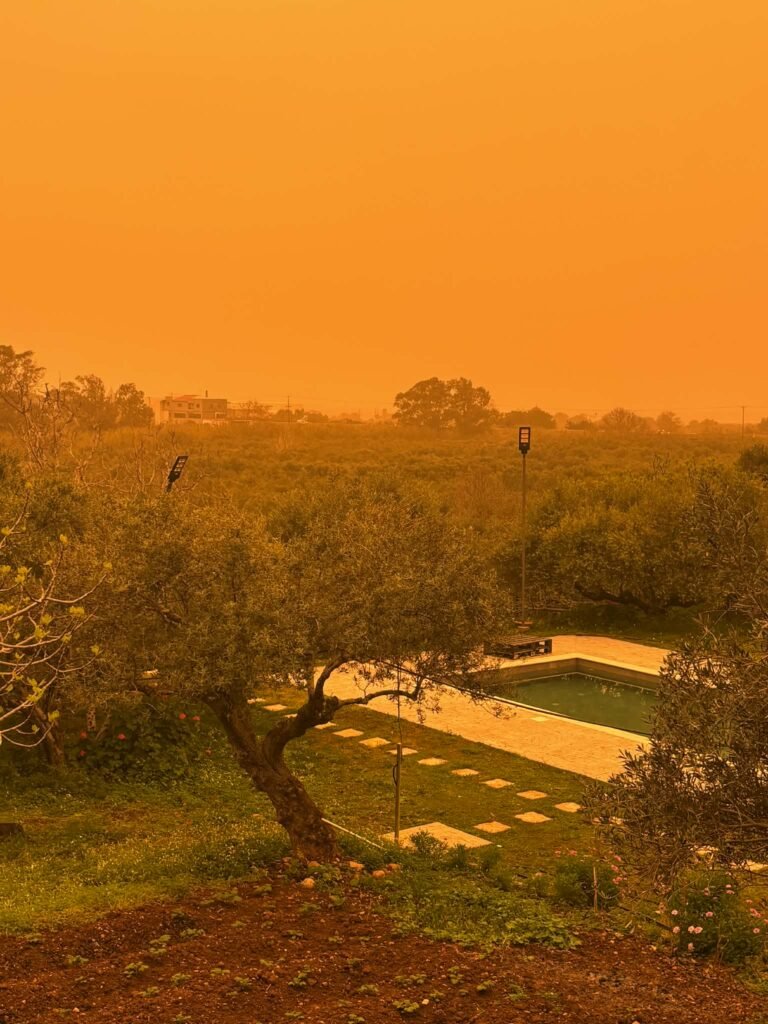
Skies over Heraklion, Rethymno, Chania, the Lassithi region, and coastal towns like Georgioupoli turned a deep orange-red. The sun shrank to a dim disc behind the haze. Streets, cars, balconies, and olive groves were coated in a layer of reddish-brown mud as rain mixed with the dust and fell from the sky.
With concentrations above 1,000 micrograms, it ranks among the most extreme dust events measured over Crete in more than a decade.
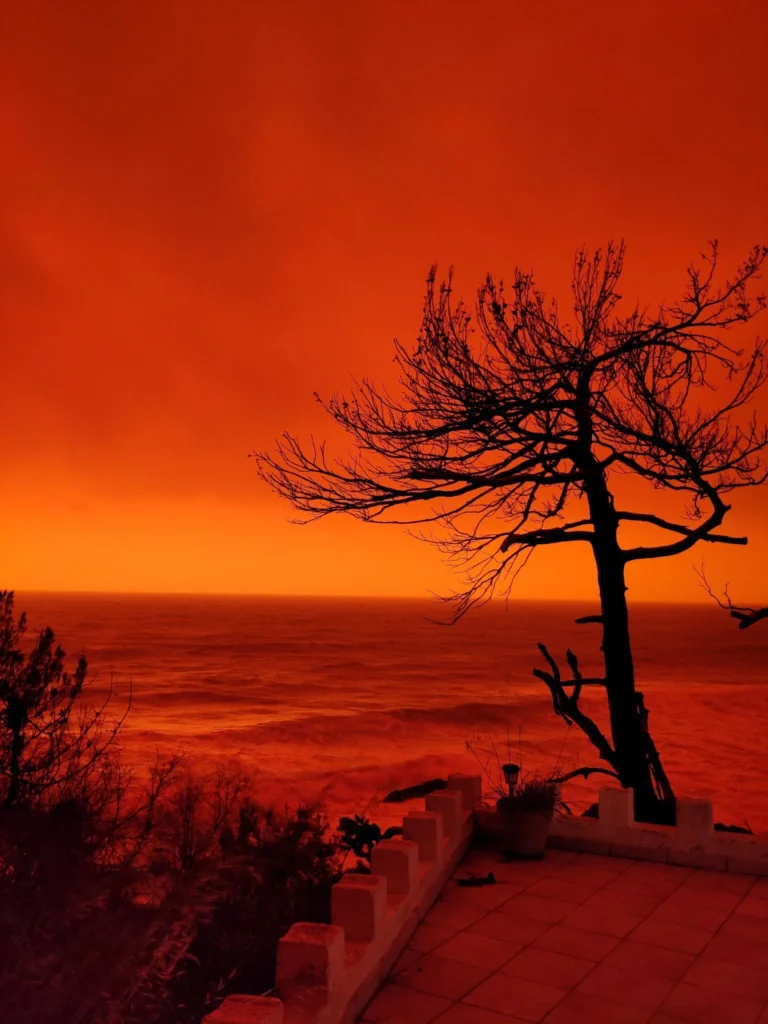
What Happened
The dense dust plume reached Crete around midday on Wednesday, April 1st, and persisted well into April 2nd. Satellite imagery showed the island still sitting under the cloud early on Thursday morning.
The dust was carried north by strong southern and south-easterly winds linked to Storm Erminio, which also brought heavy rain, thunderstorms, and a red weather warning for parts of Greece. Greece’s General Secretariat for Civil Protection placed Crete under heightened alert.
Air quality stations recorded dust concentrations above 1,000 micrograms of particles per cubic meter of air in parts of the island. That’s far above normal background levels, and among the highest measured there in recent years.
Visibility dropped to around 1,000 meters at Heraklion airport. Photos and videos shared across international media and social feeds showed people walking through an orange haze wearing masks, headlights on in the middle of the day, and sea views almost completely wiped out.
Locals described the air as “suffocating,” and many said while they’ve seen African dust before, this one crossed a line. The consensus: “We’ve seen this before, just never so intense.”
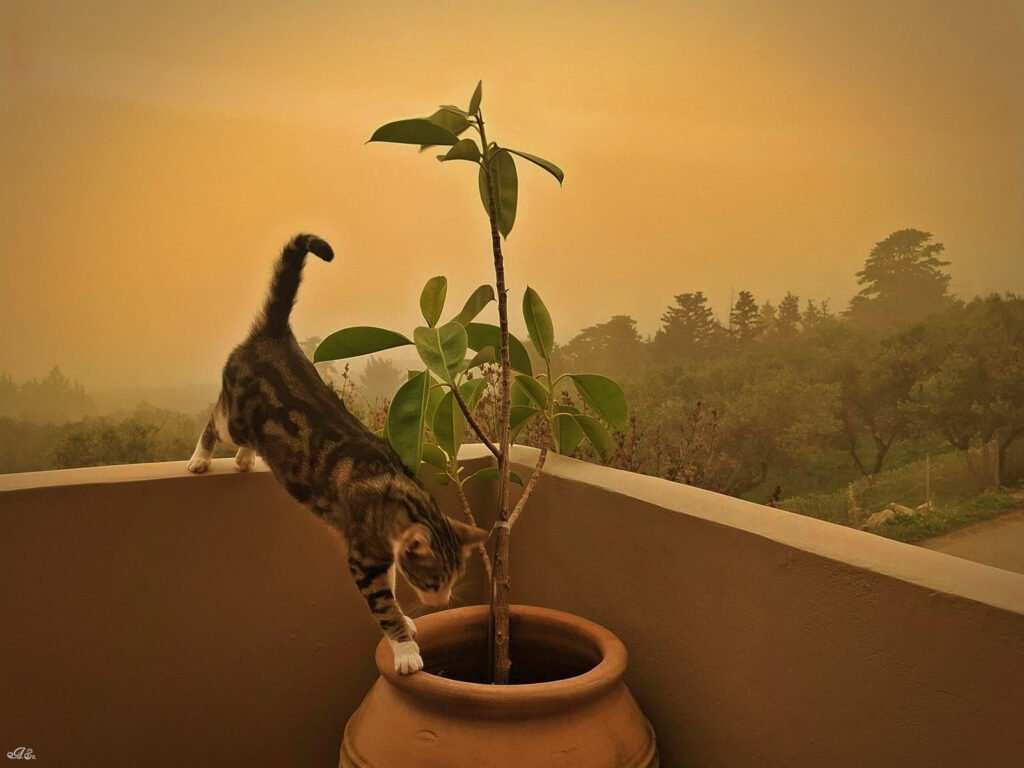
Impact on Flights, Ferries, and Daily Life
Heraklion’s “Nikos Kazantzakis” Airport saw at least nine international and two domestic flights cancelled, with a similar number of departures also grounded. A SKY Express flight from Brussels to Heraklion diverted to Athens. A British Airways flight from London to Heraklion diverted to Corfu. Several further arrivals and departures faced long delays or diversions within Greece as pilots waited for visibility to improve.
Ferries were kept in port in parts of Greece. Schools in dust-affected southern areas closed or operated under restrictions due to the weather and poor air quality.
Authorities urged residents, especially people with asthma, heart or lung disease, children, and the elderly, to limit outdoor activity, keep windows closed, and use masks or air filtration if possible. Outdoor work was partially suspended in some parts of Greece when particulate levels exceeded safety thresholds.
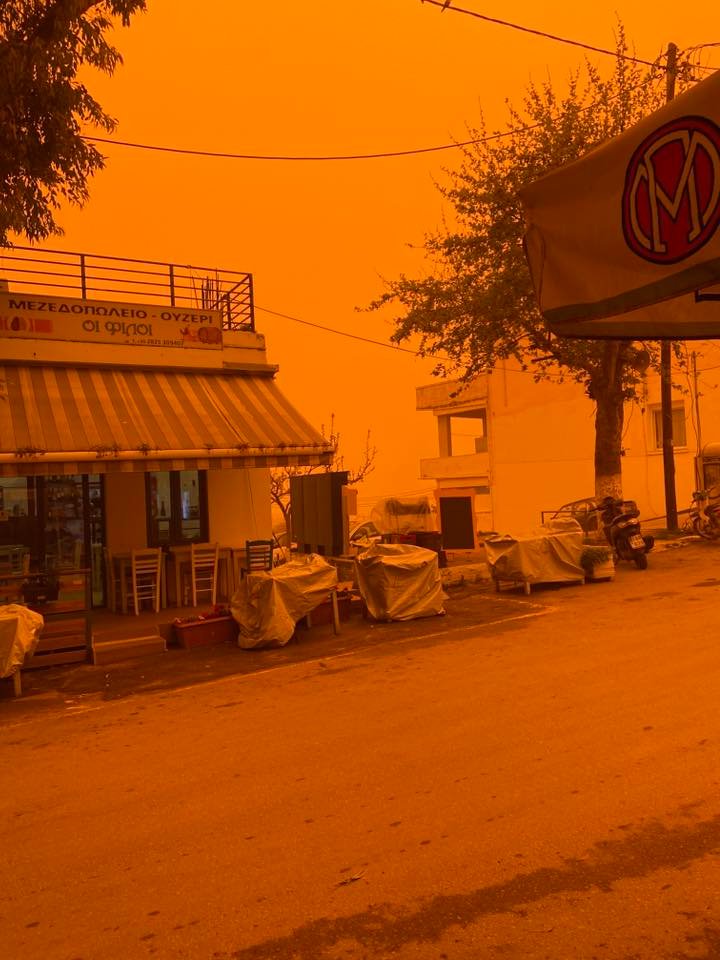
On the ground, people reported scratchy throats, stinging eyes, and a heavy, gritty feeling in the air. Outdoor cafés and tavernas were much quieter than usual. Social media filled with dramatic photos and memes comparing Crete to Mars, to the set of Dune, and joking about the Sahara being an early tourist arrival.
The island had been placed on “red alert” by Greece’s Civil Protection authorities, and municipal crews across Crete are now following through with the usual post-storm cleanup: hosing down mud-streaked streets and squares, clearing drains, and wiping fine dust off indoor surfaces that leaked through windows. The “mud rain” stains on cars and balconies are the last thing to go.
Why This Happens: Where the Dust Comes From
The dust originates in the Sahara Desert and the arid zones of North Africa. In this case, the air masses formed over Libya and moved northeast toward Crete.
Crete sits surprisingly close to the African coast. The shortest air‑line distance between Crete and Tripoli, on Libya’s north‑western coast, is about 1,100 km (685 miles), while the distance between Crete and Benghazi on the eastern Libyan coast is only around 560 km (348 miles).
That relatively short stretch of sea means it can take less than a day for a strong southerly wind to carry Saharan dust from North Africa to Cretan skies.
Here’s the basic science: strong low-pressure systems like Storm Erminio lift fine sand and dust particles high into the atmosphere, where they can travel hundreds to over a thousand kilometers across the Mediterranean. Crete lies directly downwind of North Africa when southerly and south-easterly winds dominate, so it often receives the first and strongest hit in Greece.
The orange-red color comes from how sunlight interacts with the mineral dust. The particles scatter shorter wavelengths of light and let more red light through, especially when the sun sits low. That’s what gives the sky that eerie, almost cinematic glow.
There’s also a difference between the “high-altitude haze” events, where the sky just looks milky and pale, and ground-level events like this one. When the dust drops close to the surface, it feels gritty, smells earthy, and leaves visible deposits on everything it touches.
How Often Does This Happen?
Saharan dust is a regular visitor to Crete, and locals expect hazy days every year, particularly in spring. But this event sits at the extreme end of what the island normally sees.
At a long-running monitoring station in western Crete (Akrotiri), Saharan dust outbreaks were detected on about 9.3% of days between 2003 and 2013. That’s roughly one day in ten, on average.
The influence is strongest between late winter and spring (February to April), when southerly flows are more common. Summer has the lowest frequency of intense dust events over the island.
Previous studies have identified episodes where 24-hour PM10 averages surpassed 700 micrograms per cubic meter during Saharan dust events in the eastern Mediterranean. But this year’s storm, with concentrations above 1,000 micrograms, ranks among the most extreme in more than a decade.
Researchers in Crete and southern Greece have linked extreme dust episodes to spikes in emergency room visits for respiratory issues, especially when the particles stay near the ground for extended periods.
So yes, Cretans know how to live with this. They watch the forecasts, bring the laundry in, close the shutters, and wait it out. But this one was different. This one turned day into something that felt closer to dusk, and it left the whole island under a coat of red.
How Locals Live With It
Before the dust arrives: Locals keep an eye on forecasts from the National Observatory of Athens and Greek weather sites. When “African dust” is mentioned, they know the drill. Bring washing inside, close windows, cover anything you don’t want coated in fine red dust, and expect dirty cars.
During: People with breathing difficulties avoid going out. Many wear masks if they have to. Outdoor cafés empty out, beach walks are off the table, and construction or farm work slows down or pauses altogether. Drivers switch on their headlights in the daytime, and the horizon disappears behind a wall of haze.
After: Once the wind shifts and any remaining showers pass, the big cleanup begins. Hosing down balconies, cars, and terraces. Wiping fine dust off indoor surfaces that somehow crept through sealed windows. And complaining, loudly, about the mud rain stains that seem to get into every crack.
Social feeds, meanwhile, fill with dramatic photos and dark humor. Side-by-side shots of normal blue Cretan sea views versus the red sky, captioned like sci-fi movie posters. Exasperated car owners posting “before and after” shots of vehicles turned terracotta by the mud rain. And jokes about the Sahara being Crete’s most loyal returning visitor.
What to Do If You’re in Crete During a Saharan Dust Storm
If you happen to be visiting Crete when one of these events hits, don’t panic. It looks dramatic, and it feels strange, but it passes. Here are a few simple things that will make it easier.
Stay indoors as much as you can, especially if you have asthma or any breathing issues. Keep windows and doors shut. If your accommodation has air conditioning, use it on recirculate mode rather than pulling air from outside.
If you need to go out, wear a mask if you have one. The dust particles are fine enough to irritate your throat and eyes. Sunglasses help too. Drink plenty of water and avoid strenuous outdoor activity like hiking or running.
Don’t plan to go to the beach that day. Visibility will be poor, the wind will be strong, and the air quality won’t make it enjoyable. Better to treat it as an indoor day: read, rest, and enjoy a glass of Cretan wine somewhere sheltered, rather than spending hours outside.
Check your flight status regularly and follow any advice from local authorities or your accommodation. Heraklion and Chania airports can be affected when visibility drops, and delays or diversions are possible. Keep your airline’s app handy and allow extra time.
Once it clears, expect everything outside to be coated in a thin layer of reddish dust or dried mud. Your rental car will look like it’s been on a desert rally. That’s normal. A car wash or a good rinse will sort it out.
The good news? These events rarely last more than a day or two. And when the dust lifts and the blue sky returns, Crete looks even more beautiful for the contrast.
The Weather Today: April 2nd, 2026
As of this afternoon, the dust cloud is still over Crete but it’s starting to thin as Storm Erminio moves on. Forecasts show strong winds continuing in the southern Aegean, including Crete.
Winds remain locally gale-force in the Cretan and southern Aegean seas. That helps disperse the dust in some areas, but also keeps it suspended in others. Air quality is still poor enough that vulnerable groups are being told to stay cautious.
The island is in what you might call the “windy cleanup” phase, with gradually improving visibility expected through the day as the system moves east. Still blustery, still hazy in places, but slowly returning to normal. By the time you read this, the blue should be winning.
Published on: April 2nd, 2026
Further reading:
EU Set to Ban Hand Luggage Fees: Good News for Crete-Bound Travelers

Hi there!