
Personal Reflection (Editor’s Note and personal views) can be found at the end of this article. Scroll down to read.
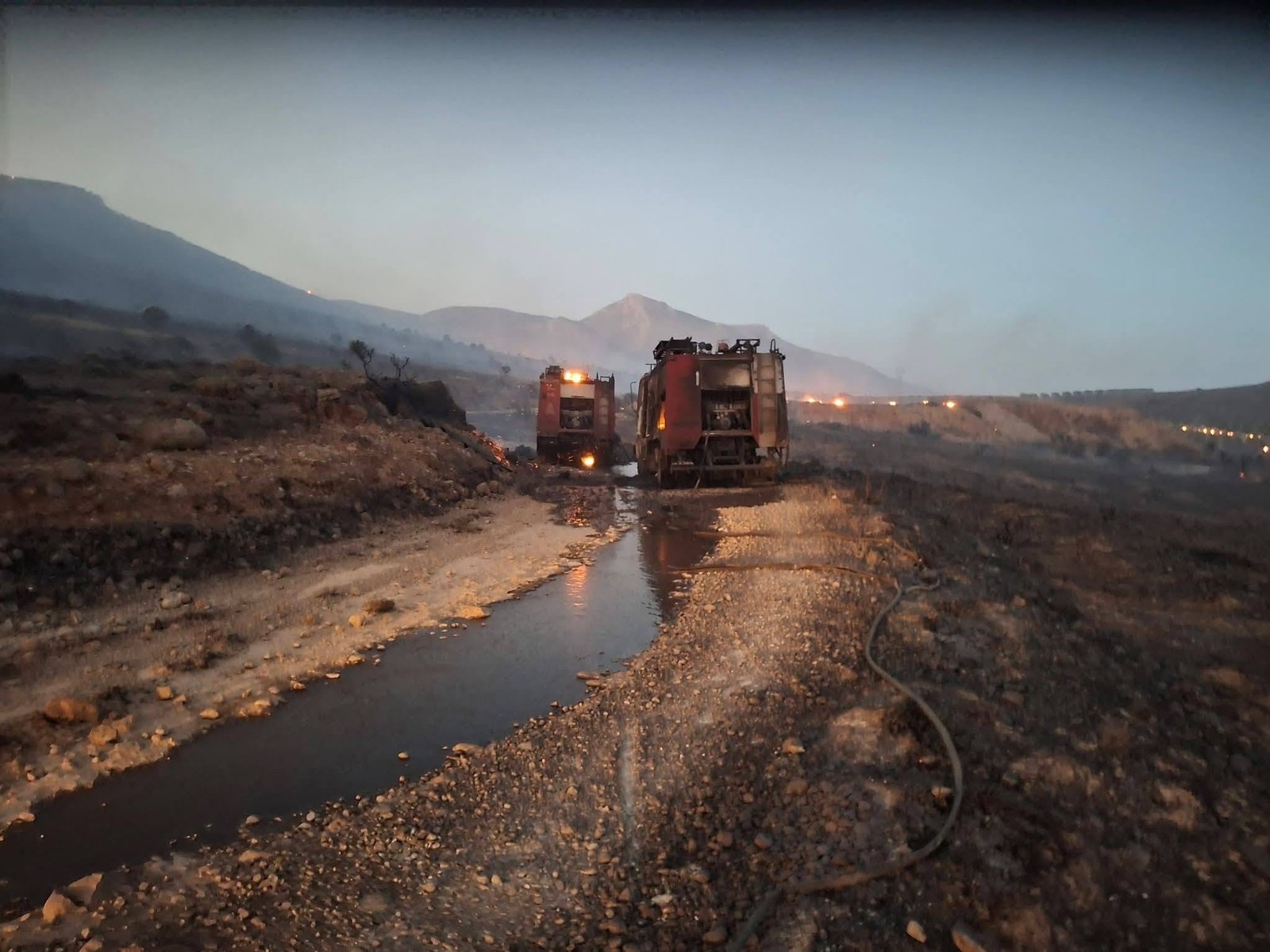
Late on Wednesday afternoon, the hills above the Libyan Sea caught fire. By nightfall the glow was visible for miles, and thousands of people along Crete’s southern coast were told to leave their homes and hotels in the dark.
This is one of the most serious wildfires Crete’s south coast has seen in years. Two firefighters lost their lives. Around 8,000 people were evacuated overnight, some of them plucked off the beaches by boat. As I write this on Thursday, crews are still watching for flare-ups while tired families begin to return.
Here’s what we know so far, what locals are living through, and what it means if you’re in Crete or heading there soon.
Where and When the Fire Started
The fire broke out around 2:30pm on Wednesday, July 29th, near the village of Krya Vrysi, in the Municipality of Agios Vasileios on the south coast of Rethymno.
It started in dry vegetation and spread fast. The wind did the rest.
Within hours, officials were warning that the active fire front had grown beyond 15 kilometers, with several fronts burning across the hills above Krya Vrysi and the south coast. Gale-force winds gusting past 100 km/h, reaching 10 to 11 on the Beaufort scale in places, made aerial water drops extremely difficult and carried embers far ahead of the main flames.
The Villages That Were Evacuated
As the fire moved toward the coast, authorities sent 112 emergency alerts and began large-scale evacuations overnight.
Around 8,000 people were moved to safety, including roughly 2,000 tourists from Agia Galini, one of southern Crete’s most loved seaside resorts. Residents, seasonal workers and holidaymakers were all told to go.
The first wave of orders covered Agia Galini, Krya Vrysi, Melambes, Sachtouria, Agios Pavlos, Agios Georgios, Triopetra, Orne, Ligres and Agia Paraskevi. As a second front opened further east, near Asomatos, more communities were told to leave, including Kerames, Ammoudi, Damnoni, Lefkogeia, Gianniou, Gefyra and the settlements down toward Limni Preveli.
Many evacuees spent the night at the municipal indoor sports hall in Moires, where the council opened its emergency shelter plan and readied school buildings for anyone who needed them.
Fire Reaches Preveli: Sea Rescues and the Palm Forest
For anyone who loves Crete, this was the hardest front to watch. A new outbreak near Asomatos pushed down through the Kourtaliotiko gorge toward Preveli, one of the island’s most beautiful and best-known corners.
With roads unsafe, the rescue moved to the water. A Hellenic Coast Guard vessel, helped by private boats, carried 51 people from the Preveli shore to Agia Galini. Volunteer crews working out of Plakias made run after run along the coastline in heavy smoke and pulled more than 80 others to safety, including tourists, local business owners and people who had been helping the firefighters.
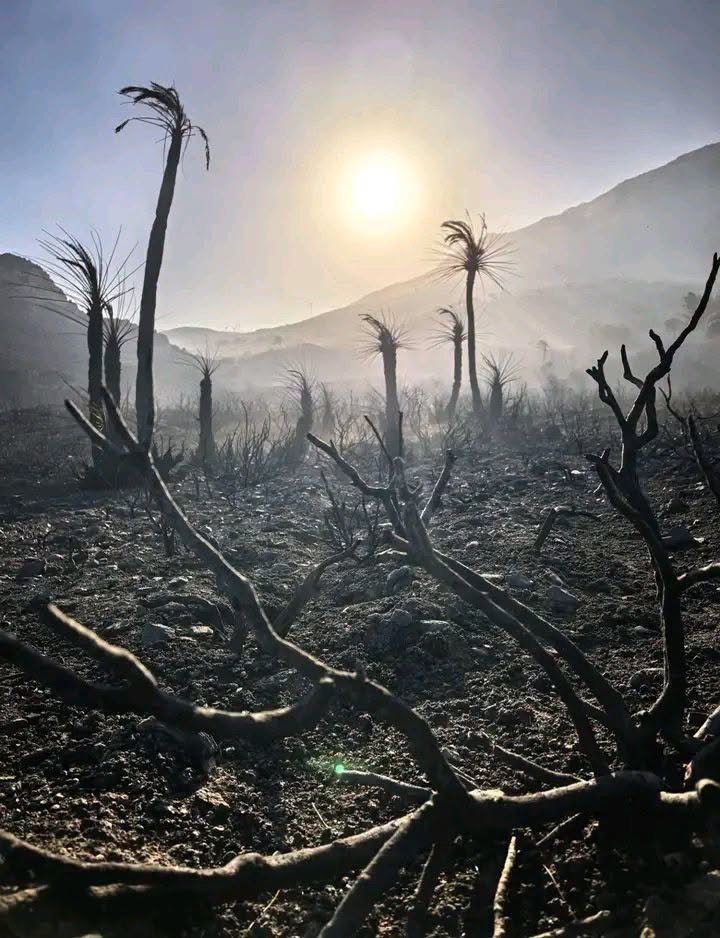
Firefighters managed to protect the historic Preveli Monastery, which sits close to where the fire came through. The palm forest wasn’t as lucky. A significant section of it burned, one of only a handful of stands of the endemic Cretan date palm anywhere in the world.
If there’s a small comfort, it’s this. That same forest burned badly back in 2010, and everyone feared it was gone for good. It came back. The palms are stubborn, and given time and a bit of protection, they tend to return.
Two Firefighters Lost
This is the part that’s hardest to write.
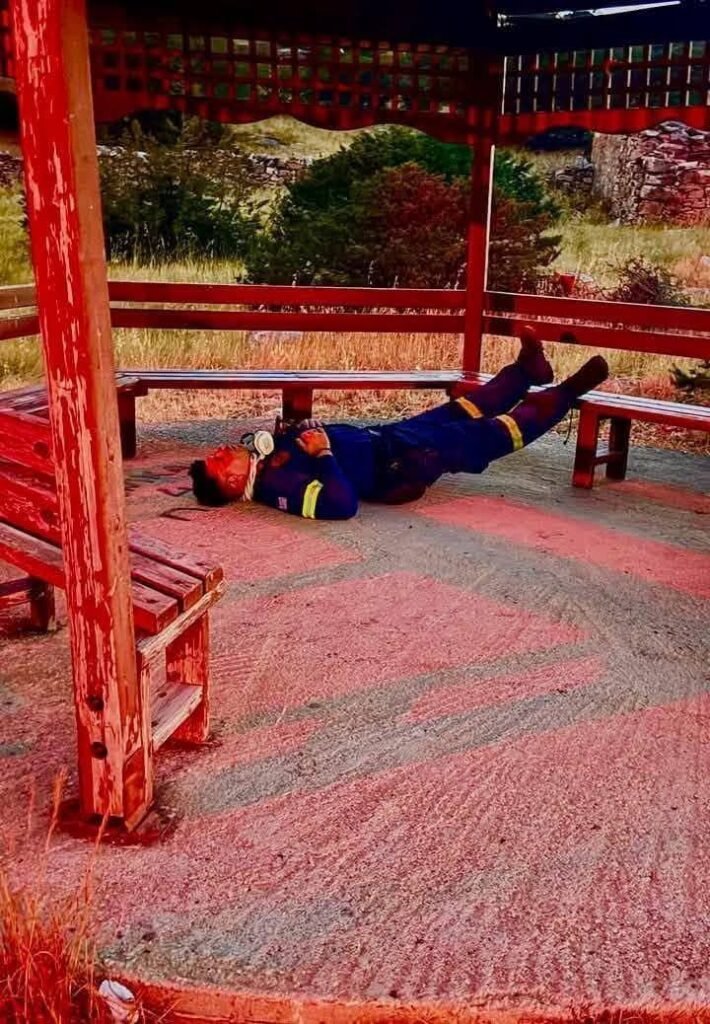
Two firefighters, aged 28 and 60, died on Wednesday. They were trapped by the flames on the road toward Melambes as the wind kept switching direction. Two volunteer civilians were also hurt, and thankfully their condition is stable.
A third firefighter, a 27-year-old officer, lost his life the same day at a separate fire near Gytheio, in the southern Peloponnese. The funerals of the two men from Crete are being held in the Rethymno villages of Gerakari and Fourfouras.
These are people who ran toward the fire so that others could run away from it. There aren’t words big enough for that kind of dedication and sacrifice.
The Response on the Ground
At the height of the emergency, more than 200 firefighters, dozens of fire engines, specialized ground crews, aircraft and helicopters were deployed to the Rethymno blaze.
The wind made everything harder. Aircraft managed only limited water drops on Wednesday, and for much of Thursday morning the gusts were so strong that helicopters couldn’t fly safely at all. That left ground crews to hold the line through the night, on foot, in the dark.
This wasn’t Crete’s only fire that week. Around the same time, smaller blazes broke out near Moroni in the Heraklion area and near Agia Triada in the Sitia region. Elsewhere in Greece, the town of Plomari on Lesvos was evacuated as a precaution during another wildfire. Greece’s fire service reported 37 wildfires across the country in a single 24-hour stretch. This was also the most serious of several fires Crete has faced this July, after earlier wildfires broke out near Heraklion, Ierapetra, Viannos and Malevizi under very high fire-risk alerts.
What Was Damaged
The full picture isn’t clear yet, and it won’t be until the fire is fully out and crews can walk the burned ground.
What we do know is that homes, farm buildings and animals were lost, along with forest, scrub, olive groves and farmland across the hills of Agios Vasileios. There were power cuts and road closures along the affected coast. The deputy regional governor, Maria Lioni, called it a “nightmare night and nightmare day” and said the damage is extensive.
The government has declared a state of emergency for the area to speed up relief and recovery.
Where Things Stand Now
The picture kept shifting through the day. By Thursday morning the main front near Krya Vrysi had calmed, but a fresh outbreak near Asomatos sent flames down toward Preveli into the evening, so this is far from over.
Evacuated residents began going home where it was safe, and tourists who left Agia Galini started returning to their hotels. Prime Minister Kyriakos Mitsotakis warned of “difficult days” ahead as the summer heat holds, and the EU said it’s preparing extra support.
For now the honest summary is this: some fronts contained, others still burning. Crete stays on high fire alert while the strong winds last.
Fires on Other Greek Islands
Crete isn’t alone this week. Over in the Cyclades, a wildfire broke out on Paros on Tuesday afternoon, July 28th, starting in low vegetation near a landfill at Kambi.
Strong winds pushed it across the south of the island, and around ten communities were told to evacuate toward the coast at Aliki and Drios. Smoke drifted as far as Ios, Sifnos and Serifos. By late Wednesday and into Thursday, the Paros fire began to ease, with two storage buildings destroyed but no reported injuries.
It’s a reminder that this is a hard summer across the whole Aegean, not just one island.
Is Crete Still Safe to Visit?
Yes, with common sense. This is the part I always want to get right, because panic helps no one and Crete is far bigger than most people picture.
The island covers more than 8,000 square kilometers. This fire hit one stretch of the south Rethymno coast. Heraklion, Chania, Rethymno town, Elounda, Agios Nikolaos and the vast majority of the island are carrying on as normal. Heraklion and Chania airports sit well outside the fire zone, and there have been no widely reported, large‑scale fire‑related flight disruptions. If you’re flying soon, check your airline’s app or website regularly, as individual flights can still be delayed or cancelled in fast‑changing conditions.
If you’re booked in or near Agia Galini, Preveli or the south Rethymno villages, treat your plans as on hold until civil protection lifts the orders. Contact your hotel or host directly, follow the 112 alerts and official Fire Service updates rather than social media rumors, and don’t drive toward closed or restricted roads even if your GPS insists.
If you’re staying anywhere else on Crete, there’s no reason to change your trip. Just be a responsible guest while the fire risk is high. Don’t light barbecues or outdoor fires, don’t toss cigarette ends, don’t park a hot car on dry grass, and take any local fire bans seriously. A little distant smoke can drift on the wind, but that’s no reason to hide indoors across the island.
Emergency Contact Information
If you’re in or near the affected area, save these numbers:
Fire Department: 199
General Emergency: 112
Ambulance: 166
Police: 100
Nearest major hospital for this area: Rethymno General Hospital (ΓΕΝΙΚΟ ΝΟΣΟΚΟΜΕΙΟ ΡΕΘΥΜΝΟΥ)
Animals in danger: Call 100 (Police)
Screenshot this if you’re anywhere close.
To the Firefighters, and Everyone Who Lost Something
Before anything else, I want to stop and say thank you, and I’m so sorry.
Thank you to every firefighter, pilot, coast guard officer, volunteer and neighbor who spent Wednesday night standing between the flames and other people’s lives. A special thank you to the three men in their small boats off Plakias, who went back again and again to bring strangers home. Two firefighters didn’t come home, and a third died on the mainland the same day. I can’t imagine the grief in Gerakari and Fourfouras this week, and my heart goes out to those families.
To the residents who watched the hills burn above their homes, to the farmers who lost animals they’d raised and fed by hand, to the workers whose season just went up in smoke, and to the visitors who packed a bag in the dark not knowing what they’d come back to: I’m thinking of you. A lot of us are.
Personal Reflection
Editor’s Note: The following represents my personal views.
I’ve now written about Cretan wildfires more times than I ever wanted to. Every summer, the same knot forms in my stomach.
The science of the immediate cause is clear enough. Heat, drought, dry fuel and vicious winds turn a single spark into a monster, and Greece had 37 fires in 24 hours this week alone. Fire seasons are getting longer and fiercer, and nobody serious argues otherwise.
But I’d be lying if I said my questions stopped there.
I keep coming back to the land itself. Crete’s hills, olive groves and forests aren’t just scenery. They’re the reason this island can feed itself, the reason villages sit where they do, the reason a grandmother can still make a meal from what grows outside her door. When that land burns, something older than any of us is lost, and it doesn’t return in a season. Watching part of the Preveli palm forest go up made that ache very real again.
So I think it’s fair to ask hard questions out loud, as people who love this place. Who benefits when land is cleared? Greece has laws meant to stop burned forest from being quietly rezoned for building, precisely because that temptation is real and old. Are those laws being enforced? Where does the water go when another luxury resort rises on a dry coast? And with so much of rural Crete being mapped for wind and solar projects, are locals truly being consulted, or just told after the decision is made?
And here’s a detail I can’t unsee. This fire tore through Agios Vasilios, the same municipality where a €500 million luxury resort, the Triopetra Bay Resort, is already permitted and moving toward construction. Triopetra itself was one of the settlements evacuated. I’m not saying those two things are connected, and the arson investigators looking into the cause haven’t said so either. But the fire hit a coastline that’s already under intense development pressure, and I’d be lying if I told you that sat comfortably with me. If you don’t know the Triopetra story, read it and make up your own mind.
And it isn’t just the resorts. Here’s one more thing I’d ask you to do. Open Greece’s public map of renewable energy projects at geo.rae.gr, switch off everything in the left menu except the wind turbines, and look at how much of rural Crete is already licensed or planned for them. Then look at where our land keeps burning, summer after summer. I’m just handing you the map and asking you to look, to notice, and to ask hard questions of the people who make these decisions.
Loving Crete means more than loving its beaches. It means paying attention, staying curious, and refusing to look away when something doesn’t add up! Think for yourself. This island has ALWAYS rewarded the people who do.
And when you can, put your money where the roots are. Eat at the family taverna. Sleep in the small guesthouse. Buy the honey and the oil from the person who made them. It’s how a place like this holds on.
Keep Crete, and everyone still fighting these fires, in your thoughts tonight.
Published on July 30th, 2026.
Further reading:
12 Traditional Cretan & Greek Herbs and Their Time-Tested Health Benefits
€500 Million Triopetra Bay Resort Transforms South Rethymno Coast as Luxury Development Wave Continues in Crete
